
2025
Exploring the dynamics of school absenteeism and crime

October 2024 – April 2026
ADR UK Research Fellowship, UKRI
Principal Investigator, with K. Pease
This study aims to aims to explore the following research questions: (a) What are the long-term effects of school absenteeism on crime at different stages of life? (b) Are the effects of school absenteeism on crime moderated by social-demographic and community-level characteristics, such as ethnicity, sex, and economic background?
Outputs:
- Buil-Gil, D., & Pease, K. (2025). From School Absences to Crime Involvement. Data Insight, ADR UK.
- Buil-Gil, D., & Pease, K. (in press). Unstructured Spare Time and Crime: Toward an Integrative Model. Crime Science.
- Buil-Gil, D. (2025). School Absences, Deprivation, and Crime Involvement – Or the Egg, the Farmer, and the Chicken. ADR UK blog.
2023
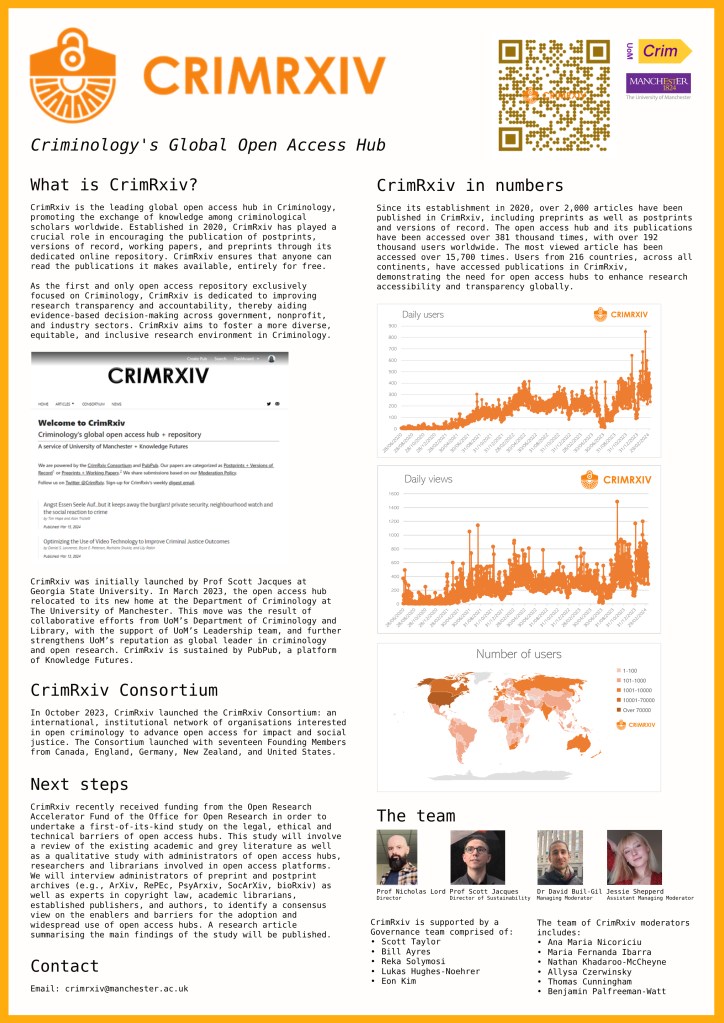
CrimRxiv – The Global Open Hub for Criminology
October 2023 – July 2025
Open Research Accelerator Fund, The University of Manchester
Principal Investigator, with J. Aldridge and S. Jacques
Funding was used to study the legal and ethical barriers of open access hubs, more effectively manage submissions to CrimRxiv, and ensure that CrimRxiv grows in publications, international reach and EDI.
Outputs:
- Sheppard, J., Buil-Gil, D., Jacques, S., & Aldridge, J. (2025). ‘It’s inevitable that open access will simply expand’: Key considerations for the growth of open access hubs. CrimRxiv.
- Sheppard, J., & Buil-Gil, D. (2025). It’s Inevitable That Open Access Will Simply Expand: Key Considerations for the Growth of Open Access Hubs: Interview Data, 2024. [data collection]. UK Data Service.
2022
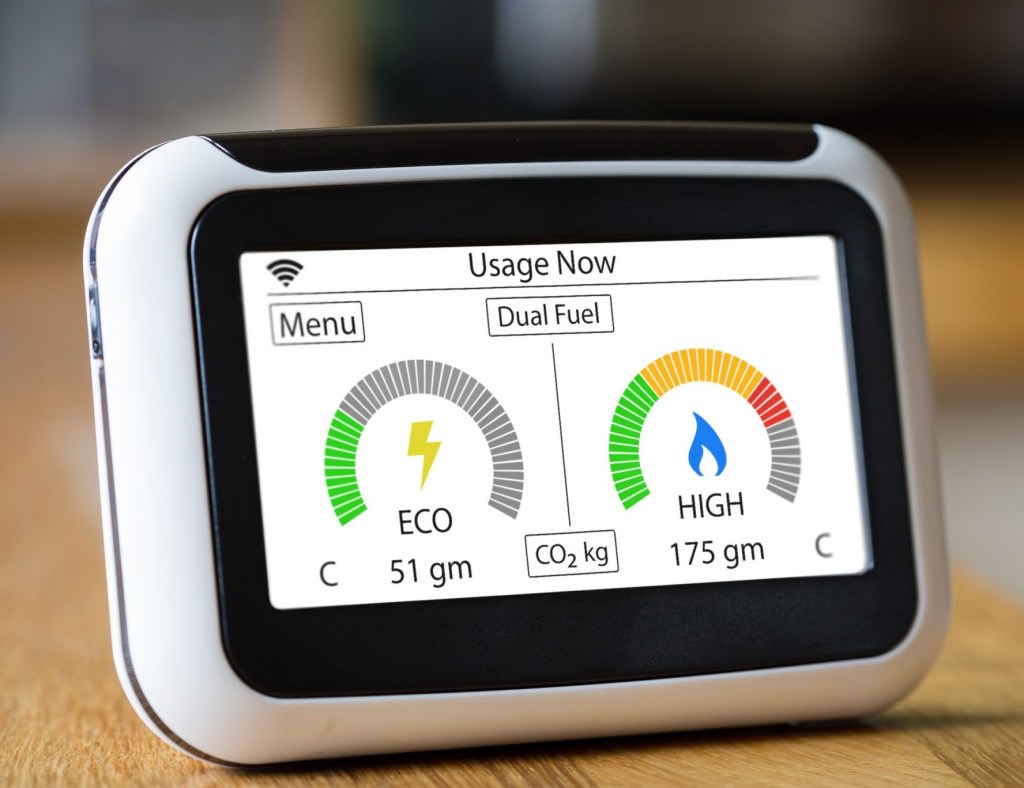
PrivIoT: Understanding and Mitigating Privacy Risks of IoT Homes with Demand-Side Management
July 2021 – December 2022
2nd Strategic Research Fund, PETRAS National Centre of Excellence for IoT Systems Cybersecurity
Co-Investigator, with J. Nicholson (PI), S. Kuenzel, S. Zakhary, L. Coventry
The PrivIoT project explored digital harms in the interaction between home IoT devices, smart meters, and Demand-Side Mangement (DSM) technologies, and develop conceptual tools to improve users’ situational awareness and agency.
Outputs:
- Buil-Gil, D., Kemp, S., Kuenzel, S., Coventry, L., Zakhary, S., Tilley, D., & Nicholson, J. (2023). The digital harms of smart home devices: A systematic literature review. Computers in Human Behavior, 145, 10770.
- Nicholson, J., Syke Lukins, R., Coventry, L., Buil-Gil, D., Kuenzel, S., Blackwell, R., Zakhary, S., & Tilley, D. (2025). “I Need to Be Convinced that I Need to Become Smart”: Older Adults Views on Consumer Products with Internet Connectivity. Journal of Risk Research, 28(2), 169-196.
- Buil-Gil, D., Nicholson, J., & Kemp, S. (2022). Smart (and Safe) Homes – public-private partnerships to mitigate the digital harms of smart home devices. Policy@Manchester blog.
2021
CyberUp: Analysing the Growth in Cybercrime during COVID-19 and Post-Pandemic Trends’
June 2020 – December 2021
Research Collaboration Fund for Research Staff, University of Manchester
Principal Investigator, with S. Kemp
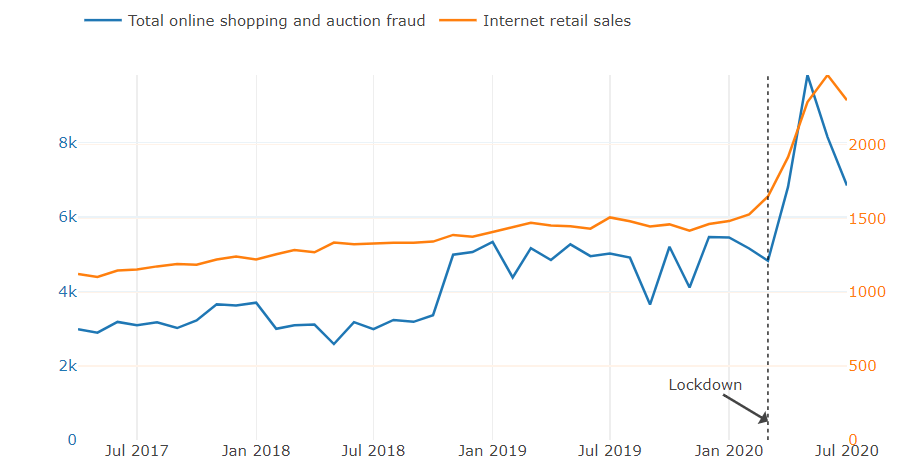
The COVID-19 crisis saw unprecedented changes in crime rates. While opportunities for a physical convergence between offenders and victims decreased during early lockdown, the massive move towards home working, home studying and online shopping contributed to a displacement of crime opportunities from offline to online environments. This project explored if, and if so when, rates of cybercrime bounce back to pre-COVID trends in the UK.
Outputs:
- Buil-Gil, D., Zeng, Y. & Kemp, S. (2021). Offline crime bounces back to pre-COVID levels, cyber stays high: interrupted time-series analysis in Northern Ireland. Crime Science, 10, 26.
- Chen, S., Ding, F., Buil-Gil, D., Hao, M., Maystadt, J., Fu, J., Dong, J., Zhuo, J., & Jiang, D. (2024). The impact of COVID-19 lockdown on fraud in the UK. Humanities and Social Sciences Communications, 11, 1676.
- Kemp, S., Buil-Gil, D., Moneva, A., Miró-Llinares, F., & Díaz-Castaño, N. (2021). Empty Streets, Busy Internet: A Time-Series Analysis of Cybercrime and Fraud Trends During COVID-19. Journal of Contemporary Criminal Justice, 37(4), 480-501.
- Buil-Gil, D., Miró-Llinares, F., Moneva, A. Kemp, S., & Díaz-Castaño, N. (2021). Cybercrime and shifts in opportunities during COVID-19: a preliminary analysis in the UK. European Societies, 23(S1), S47–S59.
- Buil-Gil, D., & Zeng, Y. (2022), Meeting you was a fake: investigating the increase in romance fraud during COVID-19. Journal of Financial Crime, 29(2), 460-475.
- Buil-Gil, D. , Moneva, A., Kemp, S., Díaz-Castaño, N., & Miró-Llinares, F. (2020). Recorded Cybercrime and Fraud Trends in UK during COVID-19. Statistical Bulletin on Crime and COVID-19 . University of Leeds.
2020
Re-Counting Crime: New Methods to Improve the Accuracy of Estimates of Crime
October 2020 – September 2022
Secondary Data Analysis Initiative, ESRC
Co-Investigator, with I. Brunton-Smith (PI), J. Pina-Sánchez, A. Cernat
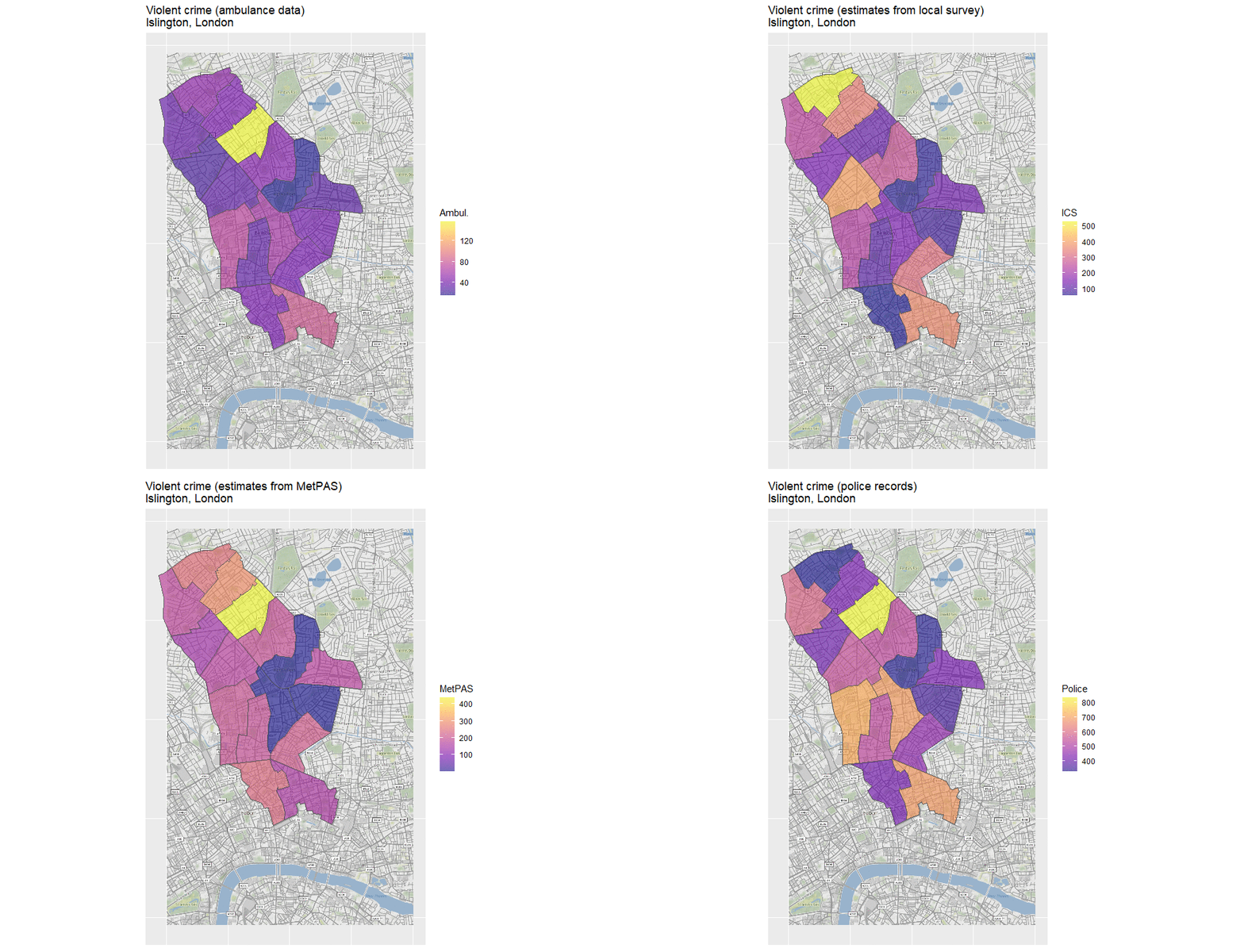
‘Re-counting Crime’ aimed to explore new statistical methods to better understand the measurement error mechanisms affecting crime data, combine crime survey estimates and police recorded crime counts, and generate bespoke adjustments and estimate corrected crime counts.
Outputs:
- Pina-Sánchez, J., Buil-Gil, D., Brunton-Smith, I., & Cernat, A. (2023). The Impact of Measurement Error in Regression Models Using Police Recorded Crime Rates. Journal of Quantitative Criminology, 39, 975–1002.
- Brunton-Smith, I., Cernat, A., Pina-Sánchez, J., & Buil-Gil, D. (2024). Estimating the Reliability of Crime Data in Geographic Areas. British Journal of Criminology, 64(6), 1347–1361.
- Buil-Gil, D., Brunton-Smith, I., Pina-Sánchez, J., & Cernat, A. (2022). Comparing measurements of violent crime in local communities: a case study in Islington, London. Police Practice and Research, 23(4), 489–506.
- Pina-Sánchez, J., Brunton-Smith, I., Buil-Gil, D., & Cernat, A. (2023). Exploring the impact of measurement error in police recorded crime rates through sensitivity analysis. Crime Science, 12, 14.
- Cernat, A., Buil-Gil, D., Brunton-Smith, I., Pina-Sánchez, J., & Murrià-Sangenís, M. (2022). Estimating Crime in Place: Moving Beyond Residence Location. Crime & Delinquency, 68(11), 2061-2091.
- Brunton-Smith, I., Cernat, A., Buil-Gil, D., & Pina-Sánchez, J. (2023). Measuring crime in place: Distinguishing between area victimisation and area offences, Significance, 20(5), 30–33.
- Brunton-Smith, I., Buil-Gil, D., Pina-Sánchez, J., Cernat, A., & Moretti, A. (2024). Using Synthetic Crime Data to Understand Patterns of Police Undercounting at the Local Level. In The Crime Data Handbook. Bristol, UK: Bristol University Press.
- Buil-Gil, D., Pina-Sánchez, J., Brunton-Smith, I., & Cernat, A. (2022). Bad data, worse predictions: How measurement error in crime data affects crime prevention. CREST Security Review, 3, 4-5.
Mapping the Bias of Police Records
June 2020 – May 2021
Campion Grant, Manchester Statistical Society
Co-Investigator, with A. Moretti (PI)
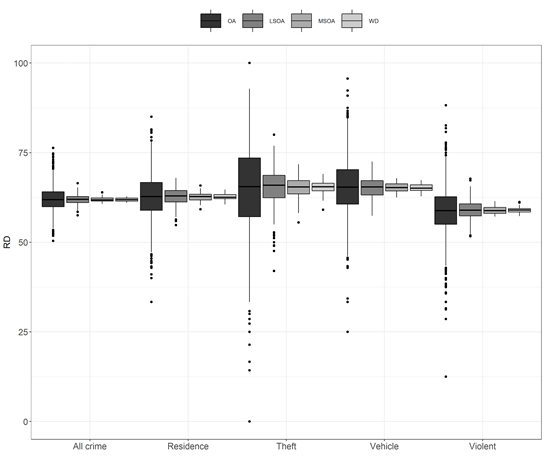
This project investigated the impact of measurement error in crime data on geographic crime analysis produced from police records at the different spatial scales. Simulation studies were used to assess whether micro-level maps are affected by a larger risk of bias than maps produced at larger scales.
Outputs:
- Buil-Gil, D., Moretti, A. & Langton, S.H. (2022). The accuracy of crime statistics: assessing the impact of police data bias on geographic crime analysis. Journal of Experimental Criminology, 18, 515–541.
- Moretti, A. & Buil-Gil, D. (2022). Mapping the bias of police records: Project final report. Manchester: Manchester Statistical Society.
2014
Comunidad de Coétnicos y Miedo al Delito

Sept 2014 – July 2015
JAEIntro Research Grants, Spanish National Research Council (CSIC)
Principal Investigator, with J. Martí Pérez
This project analysed the fear of crime of members of minority ethnic groups in Barcelona, Spain. Primary and secondary data analysis were used to explain the individual and contextual predictors of fear of crime of members of minority groups residing in different areas of the city.
Outputs:
- Buil-Gil, D. (2016). Comunidad de coétnicos y miedo al delito : estudio sobre las variables explicativas del miedo al delito de la comunidad inmigrante de la ciudad de Barcelona. BA Dissertation, Autonomous University of Barcelona.
- Buil-Gil, D. (2016). Introducción al estudio del miedo al delito: Principios teóricos. Archivos de Criminología, Seguridad Privada y Criminalística, 17, 42-55.
- Buil-Gil, D. (2017). Un Enfoque para el Estudio Ambiental del Miedo al Crimen: Aproximación Integradora al Enclave del Miedo (AIEM). Revista Electrónica de Ciencia Penal y Criminología, 19-04.
 David Buil-Gil